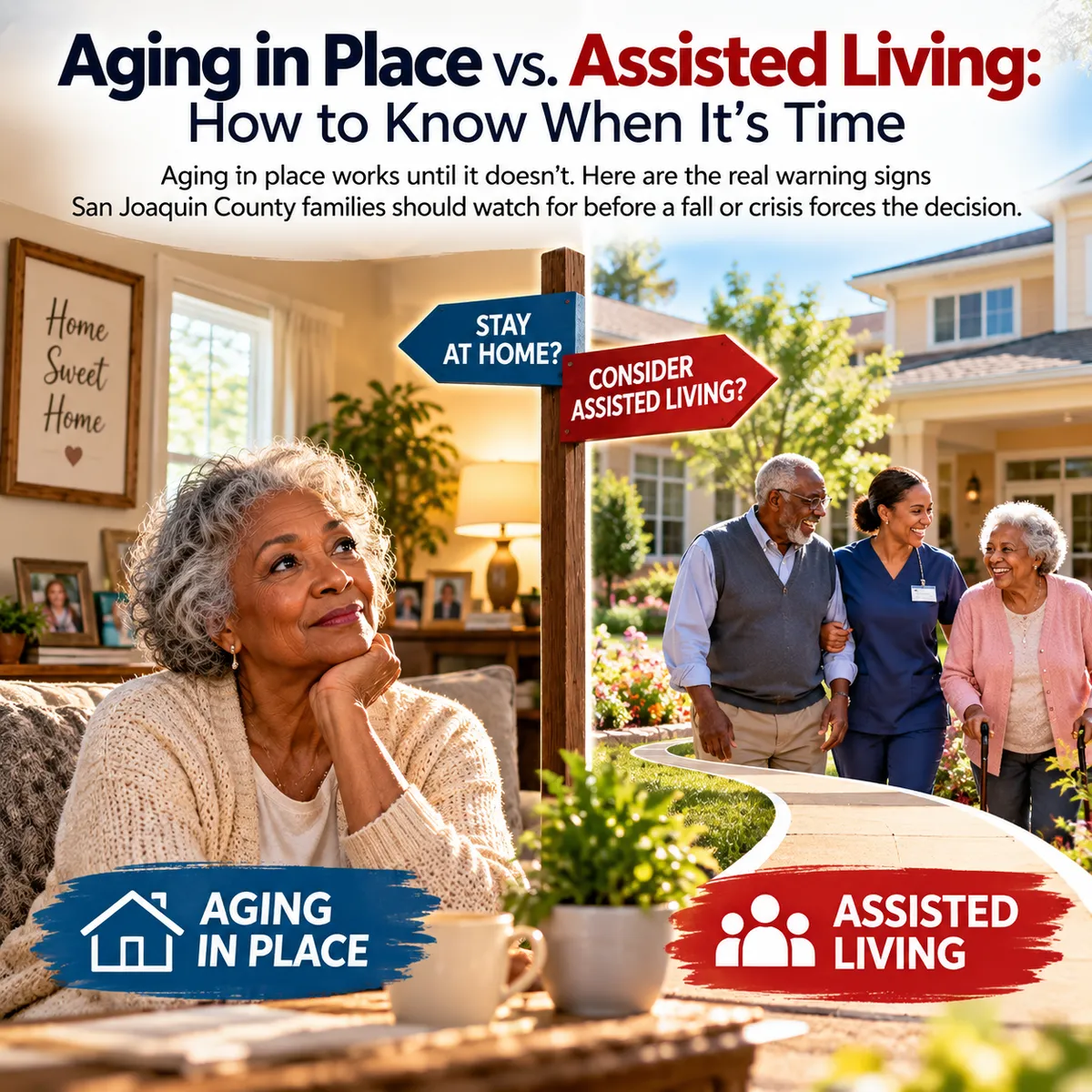
Aging in Place vs. Assisted Living: How to Know When It's Time
Almost every family starts in the same place. Mom wants to stay in her house. Dad says he's fine. Nobody wants to be the one who brings up assisted living, because it feels like giving up on independence, or worse, like you're the villain in the story. So the family waits, adjusts, checks in more often, and hopes things stabilize.
Aging in place is a good goal. It's also not a permanent guarantee, and there's a real difference between a parent who is aging safely at home and one who is aging at home because nobody has said out loud that it's no longer safe. Here's how to tell which one you're actually looking at.
Why Aging in Place Is the Default, and Why That's Fine Up to a Point
There's nothing wrong with wanting to stay home. Most people do. Familiar surroundings, a routine, a neighbor who checks in, a garden that still needs tending, these things matter for a person's sense of self, not just their comfort. If your parent is managing meals, medication, hygiene, and mobility without daily help, and the home itself is safe, aging in place is genuinely the right call. This isn't about rushing anyone out of their house.
The problem shows up when the family mistakes "she hasn't had a bad fall yet" for "she's safe." Those are not the same thing. A lot of the calls I get start with, "we always said we'd know when it was time," and then a fall, a wandering incident, or a hospital stay makes the decision for them instead. The goal is to make this call before an emergency does it for you.
Six Warning Signs It's No Longer Safe
Falls, even small ones. One fall isn't automatically a crisis, but a pattern of falls, near-falls, or new unsteadiness on stairs is the body telling you something has changed. Bruises your parent can't explain, or ones they explain away too quickly, are a signal worth taking seriously.
Medication mix-ups. Missed doses, doubled doses, or a pillbox that doesn't match what should have been taken this week is one of the most common things families miss until a pharmacist or doctor flags it.
Changes in hygiene or the home itself. Spoiled food in the fridge, unopened mail piling up, a house that used to be spotless now cluttered, or a parent wearing the same clothes for days. These are quiet signs, not dramatic ones, and that's exactly why they get missed.
Weight loss or poor nutrition. Skipped meals because cooking has become too hard, or a parent living on toast and coffee, adds up fast and is often one of the first things to slip.
Isolation. A parent who used to call friends, go to church, or run errands and now rarely leaves the house is losing more than just activity. Isolation accelerates cognitive decline and depression, and it's easy for a family to miss because phone calls can mask a lot.
Confusion or wandering. Getting lost on a familiar drive, leaving the stove on, or wandering outside without a clear purpose are not normal aging. These are safety issues that need an answer now, not a wait-and-see approach.
Unsafe driving. A parent who's had a recent fender bender, gotten lost while driving a familiar route, or that friends and neighbors have started quietly mentioning concerns about, is showing one of the clearest signs that judgment and reaction time have changed. Driving is often the single hardest independence to give up, and it's frequently one of the last things families address, even though it carries real risk to the parent and to others on the road.
If you're recognizing two or more of these, it's time to have the conversation. If you're recognizing four or more, it's time to move faster than you think.
A short, honest way to track this without relying purely on memory or gut feeling is to keep a simple log for two weeks. Note falls or near-falls, missed medications, meals skipped, and any confused or unsafe moments. Bring that log to your parent's doctor. A primary care physician can also run a quick cognitive screening in the office, which takes about ten minutes and gives the family an objective data point instead of relying only on impressions, which are easy for everyone, including the parent, to downplay.
The Conversation Nobody Wants to Have
Here's what I tell families constantly. This conversation goes better when you have it early and calmly than when a hospital social worker forces it on you during a discharge. Framing matters. This isn't "we're taking away your independence." It's "we want you safe enough to keep as much independence as possible for as long as possible." A fall that leads to a broken hip often takes away far more independence, permanently, than a planned move into the right level of care ever would.
Bring in a doctor if your parent respects that voice more than yours. Involve siblings early so one person isn't carrying the decision and the guilt alone. And go look at communities before you need one. Touring assisted living when it's not an emergency lets your parent see it's not the nursing home from their childhood memories, it's often closer to a hotel with a full activity calendar and people their own age.
What Assisted Living Actually Solves That Home Care Can't
In-home care is a real option and it works well for some families, but it has a ceiling. A caregiver coming in for a few hours a day doesn't catch the 2 a.m. fall, doesn't provide the social engagement of a dining room full of peers, and gets expensive fast once you need coverage around the clock. Assisted living solves the coverage gap, the isolation problem, and the safety monitoring problem all at once, because staff are present continuously, not scheduled in blocks.
It also solves a problem families rarely mention out loud: caregiver burnout. Adult children trying to manage a parent's care on top of a job and their own family often hit a wall long before the parent does. That's not a failure. That's a signal the current setup isn't sustainable for anyone involved, including the parent, who often feels the strain their child is under.
I've sat with families where the adult child was driving over forty-five minutes each way, twice a day, to check on a parent, on top of a full time job and their own kids. By the time they called me, they were exhausted, guilty, and convinced they'd somehow let their parent down by needing help. Six weeks after that parent moved into an assisted living community five minutes from the daughter's house, both of them told me separately it was the best decision the family had made in years. The parent got a social life back. The daughter got to go back to being a daughter instead of a full-time, unpaid case manager.
How to Decide Without the Guilt
You are not failing your parent by recognizing they need more support than you or a home health aide can provide. You are doing exactly what a good adult child does, which is paying attention and acting on what you see instead of what you wish were true.
If you're seeing the warning signs above and you're not sure whether it's time, that uncertainty is exactly why a placement consultation exists. We'll walk through what's actually happening day to day, not just symptoms in a list, and tell you honestly whether assisted living, memory care, or continued in-home support is the right fit right now. No pressure, no sales pitch, just a clear answer so your family can stop guessing and start planning. Call for a free in-home or phone assessment this week.